News
Organic Farming: A Year in the Vineyard
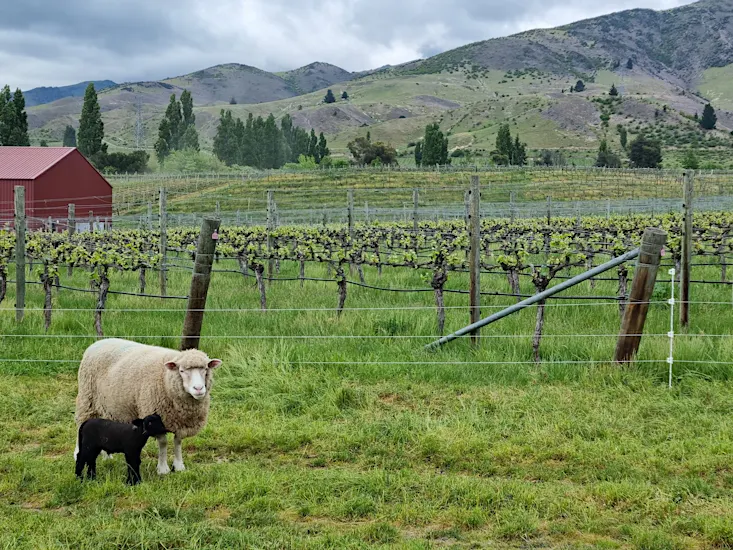
Recently, Terra Sancta was once again certified organic. It is a milestone we are always pleased to reach, although the certification itself is only a small part of the story. The audit lasts a few days, but the farming takes place every day of the year.
Organic farming begins with a different way of looking at a vineyard. Rather than seeing rows of vines, we see a living ecosystem. Healthy soils support healthy vines, and healthy vines produce better fruit. Better fruit creates wines that more clearly express the place from which they come. As a wise man once said, “You can’t outperform your vineyards.” We have found this to be true.
Of course, believing this is one thing, farming this way is another.

Every spray applied throughout the season must meet strict organic standards and every application is recorded and traceable back to the vineyard block. Every tonne of compost, every cover crop sown between the rows, every grazing rotation of our Babydoll sheep, every cultivation pass and every vineyard operation forms part of a complete picture of how the vineyard has been cared for.
The winery follows the same philosophy. Every wine is fully traceable back to the vineyard and block from which it came. Native fermentations, thoughtful handling and minimal intervention allow the vineyard, rather than the winery, to take the leading role. Some years make this easier than others; the 2026 growing season certainly did not. An exceptionally cool, wet summer created significant disease pressure across Central Otago. Vineyard work became increasingly dictated by the weather, with our team often beginning at 2 am to take advantage of the short windows when conditions allowed. Organic farming offers no easy shortcuts. Instead, it asks for observation and constant presence. Every decision matters because every decision has consequences for the health of the vineyard.

Over time, these decisions begin to change a place. Our Babydoll sheep have become an essential part of the vineyard team, managing the vineyard floor while returning nutrients to the soil. The hens happily scratch amongst the vines; insects and birdlife have increased, and each season the cover crops contribute a little more diversity beneath the vines. The vineyard feels increasingly alive. Our soils now contain naturally high levels of available nitrogen despite no synthetic fertiliser. These changes are not always dramatic, and they do not happen overnight. Like great wine, they are the result of patience.

Back in 2011, Riverblock was struggling. It barely produced enough Chardonnay to justify making a vintage. Rather than accepting its limitations, we asked a different question: what did this block need? That question led us down the path of organic and regenerative farming. We committed wholeheartedly, and before long a truck filled with 600 chickens arrived at Terra Sancta. “The Ladies”, as they quickly became known, enthusiastically took up residence and, to this day, remain convinced they own the place. As they scratched beneath the vines, they revealed something we hadn’t expected—a beautiful seam of limestone running through Riverblock. Those same limestone soils are now reflected in the wine, contributing to the fine mineral line that has become a hallmark of our Chardonnay. More importantly, the vineyard itself began to change. Soil health improved, and the vines responded. Year by year, Riverblock found new vitality. At the same time, we continued refining our approach in the winery, allowing the vineyard to speak more clearly with each vintage. The result is Riverblock Chardonnay 2024, awarded 97 Points by James Suckling—placing it among New Zealand’s finest Chardonnays. To think it all began with a vineyard that struggled to produce fruit, a flock of determined hens, and the belief that if you care for the land, it will eventually reveal its potential.
Perhaps this is what organic farming has taught us more than anything else. The best outcomes rarely come from asking, “What is the quickest solution?” They come from asking, “What is best for this place?” Every season we learn a little more about Bannockburn and every vintage teaches us something new. Organic certification recognises that ongoing commitment to caring for this special place. And that journey continues tomorrow morning.
